


You Just Lost Your Job. Before You Start Freelancing, This is What You Need to Know

I am writing this in June 2026. India is seeing layoffs across many sectors, and recruitment is slow too. IT companies are calling it "workforce optimization."
I know a few startups that raised crores on a pitch deck shut down without a press release. Manufacturing units automate a floor and shed 200 jobs in an afternoon. Mid-level managers at legacy firms are now being replaced by leaner structures.
The gig platforms that once promised flexibility are now tightening contracts and reducing payouts. No sector has been left untouched, and no level of experience has made anyone entirely immune. Freelancers have been affected.
So here we are. I started writing these articles on Freelance Resources India to help beginner freelancers shorten their learning curves. This article is for those who have lost their jobs and want to take up freelancing.
The Impact of Job Loss
If you have a family, the loss affects more than just your professional life. It impacts your every living minute and even your sleep. You are holding a lot in yourself, silently, and keeping up appearances while trying to figure out your next move.
Freelancing might or might not be the right path for you. Many people who lost jobs and moved into freelancing will tell you it was the best thing that happened to them, even though it did not feel that way at the time.
But before you jump in, here's an honest picture of what freelancing actually involves.
The Myth: Freelancing Is Just Finding Clients and Doing the Work
Most people who are new to freelancing think the process looks like this:
Write a proposal or bid on a platform
Win a project
Do the work
Get paid
Repeat
This is partially correct, but very incomplete. It's like saying that running a restaurant is just about cooking food.
There are a whole lot of things that make a freelance business actually function: the systems, the protections, the positioning, the financial hygiene, the client management, and the slow, steady work of building a reputation.
FREELANCING IS A SMALL BUSINESS
If you don't treat it like a business, you are not going to go too far.
Freelancing Is A Stack of Systems Running Simultaneously
Here is a mental model that will help you succeed as a freelancer.
A functioning freelance business is not a single activity. It is several systems running at the same time, each one supporting the others.
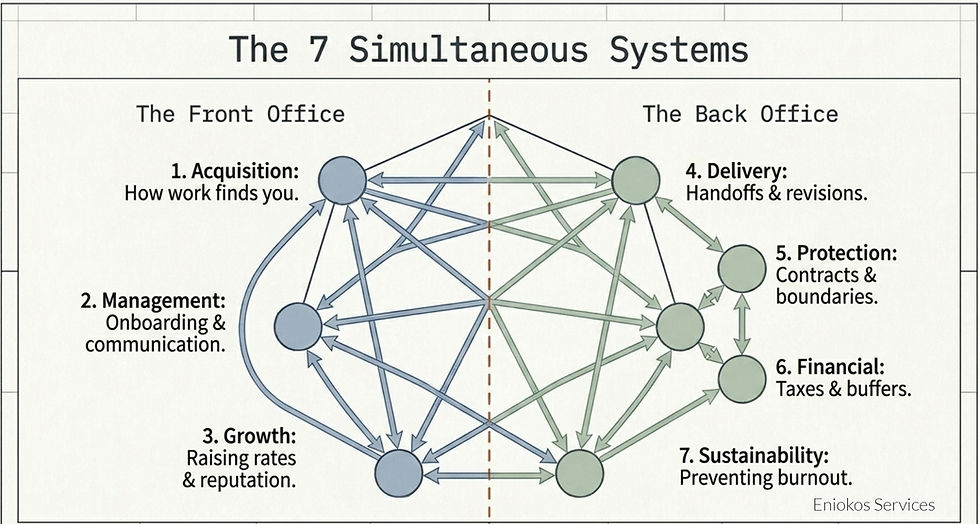
1. A Client Acquisition System
How does work find you? How do you find work? Yes, you created a profile on Upwork. But getting clients requires a system that includes your network (the people who already know your work), your online presence (what someone sees when they search your name), your content or activity on platforms like LinkedIn, and your outreach strategy.
2. A Client Management System
Once a client is interested, what happens next? How do you onboard them? How do you run a discovery call? How do you gather requirements without going back and forth endlessly? How do you give status updates without being chased? Without a system, every client relationship becomes improvised. It may work initially, but improvisation at scale leads to overwhelm, missed expectations, and disputes.
3. A Delivery System
How do you actually hand over the completed work? Where do files go? How are revisions requested and tracked? How is final approval obtained? These sound like small logistics questions but are very important. Many freelancers lose time, money, and clients because they never defined these things.
4. A Protection System
Don't skip this! A protection system means a contract that specifies what you are delivering and what you are not. It means taking an advance payment before starting work, typically 30 to 50 percent. It means defining how many revision rounds are included. It means putting everything in writing, even if it is just a WhatsApp confirmation. Without protection, a single bad client can cost you weeks of work and leave you with nothing.
5. A Financial System
Freelance income is irregular. Payments arrive late. Projects stall. A slow month can follow three busy ones. A financial system means tracking what you earn and what you spend; setting aside money for taxes (including GST implications if your annual income crosses the threshold and TDS deductions that clients may make); and maintaining enough of a buffer that a delayed payment does not become a crisis.
6. A Growth System
How do you raise your rates over time? How do you move from low-paying platform projects to direct, higher-paying clients? How do you build a reputation that brings inbound work instead of outbound hustle?
A growth system is what separates freelancers who are still charging the same rates after three years from those who have doubled or tripled their income. It includes asking for testimonials, following up with past clients, refining your positioning, and gradually moving toward the clients and projects that suit you best.
7. A Personal Sustainability System
A sustainability system means knowing your working hours and protecting them. It means saying no to projects that are not worth the drain. It means building a workload that you can actually maintain without burning out. Freelancing can be deeply flexible, but that flexibility will work against you if you have no structure at all.
A Practical Roadmap to Start Freelancing: The First 60 Days
Here is a realistic roadmap for someone starting from scratch after a job loss.
Phase 1: Stabilize Before You Build (Duration 1 week to 10 days)
Freelancing takes time to generate income, especially in the beginning. Before you invest heavily in building your freelance setup, you need to reduce financial pressure.
So when you start to work on rebuilding your new career, take a few days to analyze your situation, availability of emergency funds, and how long they will last. Draw up an austerity plan.
Remember, starting a freelance career is also going to cost money at the beginning, and that is why you should think of it as a business with an initial investment.
If you need to earn something right away, look at part-time options that can provide you something right away.
This might mean tutoring whatever you are capable of teaching well (e.g., in person or on platforms like UrbanPro or Superprof).
It might mean part-time or contract work through a staffing firm.
It might mean temporarily assisting another freelancer in exchange for pay and experience. There might be freelancers who want to subcontract or need assistance with a large project.
The goal here is to buy yourself time to do freelancing properly instead of desperately.
A person under severe financial pressure makes poor decisions. Every rejected proposal feels catastrophic. Every slow week feels like proof that it will never work. Reducing that pressure, even partially, changes how you think and how you act.
Weeks 1 to 2: Choose One Service
Research what kind of jobs related to your skills are being posted on the chosen platform. What proportion of those are getting hired? Are there reviews on the profiles of existing freelancers that show regular jobs in that area? What are the skills of freelancers who have risen up in the ranks?
Create a profile on your chosen platform. Pick one service and offer it to one kind of client. Not two services. Not a portfolio of skills. One. If you have two similar services, then, find an umbrella niche that covers both. If you want to offer two disparate services, do so on separate platforms. But for starts, I would strongly suggest choosing one niche and sticking to it for at least 6 months.
The temptation to offer everything, especially when you are feeling financially vulnerable, is understandable. But generalists without a clear expertise typically get paid less and win fewer projects.
Answer one question: what specific problem will I solve for what specific kind of client?
WordPress development for small business owners
Technical writing for SaaS companies
Data analysis and reporting for e-commerce brands
Video editing for educational content creators
Mobile app testing for early-stage startups
One service. One audience. One outcome. Everything else can come later.
I diversified into multiple services later as my team grew, but I started with just writing jobs.
Weeks 1 to 3: Learn How Freelancing Works
This is not the same as learning your craft. You likely already know your craft. What you may not know is how freelancing as a business actually operates.
There are a few areas worth investing learning time in during these early weeks:
Client acquisition: Networking, referrals, LinkedIn, freelance platforms, and cold outreach. These are different channels with different timelines. Referrals are fast but depend on your existing relationships. Platforms are accessible but competitive and slow to build. LinkedIn takes consistency but can produce high-quality direct clients over time.
Proposal writing: How to read a client brief, identify the real problem underneath the stated requirement, and write a proposal that addresses that problem. Don't start with stating your skills. Most proposals fail because they are about the freelancer, not the client. Start by showing a deep understanding of what the project and client need, and then, how you can help.
Pricing: Hourly, project-based, and retainer models each have different appropriate use cases. Understanding the difference, and understanding what the market pays for your service, prevents the two most common pricing mistakes: undercharging out of desperation, and overcharging without the portfolio to support it.
Scope management: How to define what is included in a project, what is not, and how to handle requests that go beyond the original agreement. This is where most beginners lose money.
Month 1: Build Your Professional Assets
Once you have stabilized your income, chosen your service, and learned the basics, you are ready to build the visible parts of your freelance business.
A minimum viable portfolio contains three to five examples of relevant work. If you do not have client projects yet, personal projects, volunteer work, open-source contributions, or sample work you created to demonstrate your skills all count. What matters is that the work is real, relevant, and demonstrates the outcome you can produce.
Your professional bio should focus on outcomes, not on your feelings about your work. "I am passionate about data analytics" is not clear about the outcome being offered. "I help e-commerce brands identify revenue leakage through sales funnel analysis" tells them exactly what you do and what they get.
At minimum, set up a LinkedIn profile and a simple portfolio website. A free website is perfectly fine at this stage. The goal is not polish; the goal is to exist on the internet in a way that a prospective client can find and evaluate you.

Month 2: Build Your Client System
This is the stage most beginners never reach, and it is the one that separates professional freelancers from people who are just doing gig work.

Before your first client arrives, have these ready:
An inquiry form (a simple Google Form works) that collects the client's name, email, project requirements, budget, and deadline. This saves time and filters out vague, uncommitted inquiries.
A proposal template that you can adapt quickly rather than writing from scratch each time.
A basic contract that specifies deliverables, timeline, revision rounds, and payment terms. Free contract templates exist — you do not need a lawyer to start.
An invoice template, ready before your first project begins.
A clear delivery process: how files are shared, how revisions are requested, how final approval is obtained.
These tools exist so that when work comes in, you handle it professionally and efficiently — not improvised and stressed.
Protecting Yourself: The Rules That Save You From Expensive Mistakes
Freelancing without basic protection is just risky. Here are some rules, sticking to which will help you a lot.
As far as possible, always take an advance. 30 to 50 percent upfront, before work begins. This is standard practice in professional freelancing. A client who refuses to pay an advance before any work has started is a client who may also refuse to pay the balance after the work is done. An advance filters out bad-faith clients and gives you something to stand on if the project falls apart.
Some freelance platforms offer escrow, which protects you a bit. Make sure all the milestones and the project fee is funded. Clients can find clever ways to cheat you, especially if you are new.
Define revision rounds in writing. "Includes two revision rounds" is an important boundary. Without it, revisions are unlimited by default, and some clients will treat your work like a buffet.
Write down exactly what is included. Scope creep — the slow expansion of a project beyond its original brief — is one of the most common ways freelancers lose money. The fix is simple: write what you will deliver, and write what you will not.
Put everything in writing. A WhatsApp message confirming an agreement is better than a verbal conversation. A signed contract or an email agreement is better than a WhatsApp message. Written confirmation, at whatever level of formality, creates a record you can return to when there are conflicts.
Keep copies of everything. Emails, contracts, project files, invoices. Store them somewhere you can access them regardless of what device you are using.
Getting Your First Client
Use multiple channels/networks at the same time, not sequentially. Waiting for one channel to work before trying another will cost you time.
Your warm network is your highest-probability channel. Friends, former colleagues, classmates, alumni groups, and relatives are people who already know you and trust your competence. Let them know what you are doing now and what kinds of projects you are looking for. You do not need to pitch hard. You just need to be known.
Freelance platforms (Upwork, Freelancer.com, Toptal for more experienced freelancers) give you access to clients who are actively looking. The competition is tough, and building a profile takes time, but it is a legitimate channel with active demand.
LinkedIn is underused by most Indian freelancers. Consistent posting about your area of expertise, combined with active engagement in relevant communities, produces results over a three-to-six-month horizon. It is slow but compounds.
Communities like Reddit, Discord servers, Facebook groups, Slack communities in your niche, put you in front of people who are relevant to the problems you solve.
Direct outreach to local businesses, small agencies, and startups is really underrated. A small business owner who needs a website built is not browsing Upwork for sure. They are trying to run their business. If you reach out with a clear, specific offer, you have the field largely to yourself.
If you want a structured starting point, the 7-Day First Client Action Plan walks you through exactly this — one task per day, from picking your service to sending your first outreach. It also includes outreach templates, a lead tracker, and a rates reference so you are not building everything from scratch.

Basic Operational Hygiene
This comprises habits to build before your first client arrives.
Create a separate folder for every project — on your computer and on cloud storage — and keep all files, communications, briefs, and drafts for that project in one place.
Name files clearly and consistently, with version numbers if needed, so you and your client are never confused about which file is final.
Be mindful of confidentiality: client materials, business data, unreleased work, and any personal information a client shares with you are not yours to use, share, or reference publicly.
This sounds obvious, but many beginners inadvertently post client work as portfolio samples, or discuss project details in public communities, without realizing the professional and legal implications. A simple rule: treat everything a client gives you as confidential unless they have explicitly told you otherwise.
Honest Expectations
Most freelancers take three to six months to gain real traction. Some get lucky earlier. A few take longer. The timeline depends on your network, your niche, the quality of your positioning, and a reasonable amount of luck. What it does not depend on is how hard you hustle in week one.
Here are the mistakes beginners make most often:
Expecting clients in two weeks, then concluding that freelancing "does not work" when they do not arrive.
Changing their niche or service every few weeks because nothing is converting yet — which resets the clock every time.
Taking every project that comes in, regardless of fit, leading to low-paying work, bad clients, and no time for better opportunities.
Undercharging dramatically to win work, then resenting the work they win.
Waiting until everything is perfect before starting — the portfolio, the website, the LinkedIn profile, the contract template — and therefore never starting.
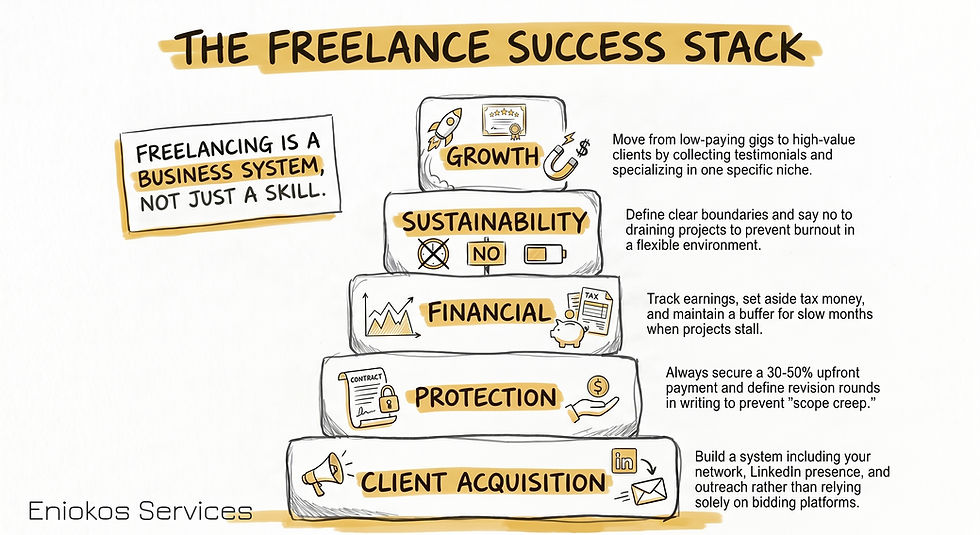
The most important reframe for a new freelancer is this: freelancing is a business system, not just a skill. A mediocre freelancer who has a clear niche, a functioning client acquisition process, professional systems, and basic protection will typically out-earn a more talented freelancer who has none of these things. Competence gets you to the table. Everything else keeps you there.
Where to Go From Here
If you have read this far, do know that you are already thinking about freelancing differently than most people who start. This thoughtful approach will help you to differentiate yourself in this competitive market.
The next step is not to do everything at once. It is to take the first step with the right priority: stabilize your income, choose your service, and start learning how the business side actually works, not just the craft side.
You did not choose this moment. But you can choose what you build from it.
You may want to check out:


